Back to research
Hydroinformatics · WebGIS · Spatial Databases

Hydroinformatics & Decision Support

Research Brief Updated May 8, 2026

PostGIS-driven evacuation routing, pluvial flood index design for NOAA's NextGen framework, deep learning weather forecasting, WebGIS risk communication dashboards, and field-to-database geospatial workflows — the full applied stack connecting spatial data to operational decisions.
PostGISWebGISArcGISSurveyingAutomation
Infrastructure vulnerability and risk assessment

What This Work Covers

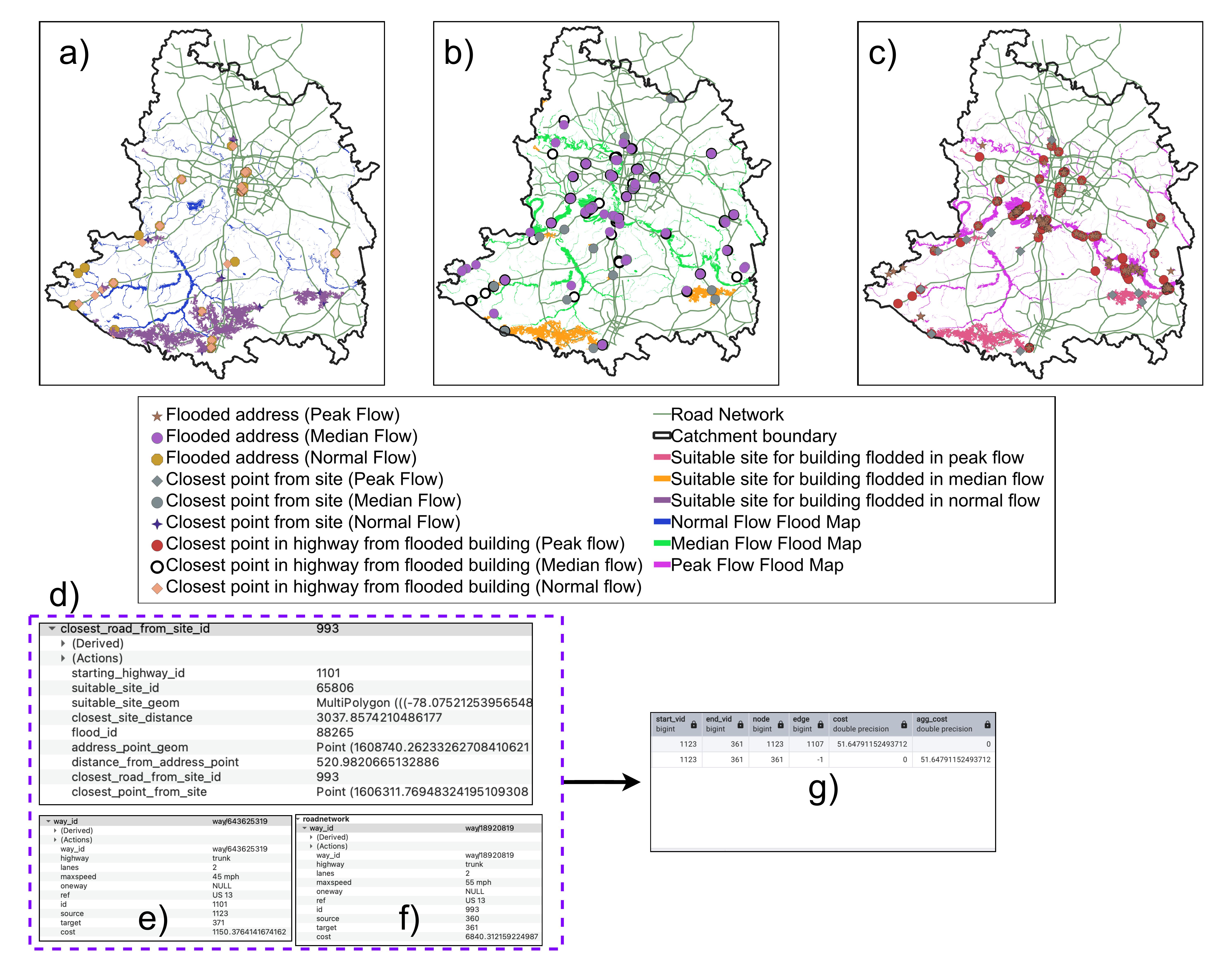
  • Dynamic Evacuation Framework — normalized PostgreSQL/PostGIS geodatabase storing road networks, flood extents, and demographic layers; pgRouting-based optimization of evacuation routes as flood magnitude and blocked segments change in real time; WebGIS visualization component for communicating routing recommendations to planners.
  • Pluvial flood indices for CONUS — spatial index design and validation framework for representing surface runoff and pluvial flooding within NOAA's NextGen Water Modeling Framework; extends operational flood mapping from fluvial to urban and hillslope contexts.
  • Deep learning weather forecasting — LSTM-based multi-station meteorological forecasting applied to Kaski District, Nepal; demonstrates data-driven prediction in data-sparse mountain environments and supports the broader case for ML in environmental monitoring.
  • WebGIS and spatial communication — ArcGIS Online, Google Earth Engine, Leaflet, and Streamlit dashboards built for flood risk and spatial decision communication; translates model outputs into interfaces usable by non-technical stakeholders.
  • Field-to-database workflows — UAV orthophoto processing, DGPS and total station surveys, participatory HOT/OSM mapping, and GDAL-based raster pipelines; the practical data acquisition and processing layer behind the analytical work.

Why It Matters

Research outputs in water science only create value when they reach decision-makers — and that requires the full applied stack: reliable spatial databases, routing logic that updates as conditions change, interfaces that communicate uncertainty clearly, and field methods that produce trustworthy inputs. This theme spans that entire chain, from total station surveys in Nepal to PostGIS schemas for real-time routing to WebGIS dashboards for emergency planners. It shows that geospatial work is not just analysis — it is infrastructure for action.

Related Outputs