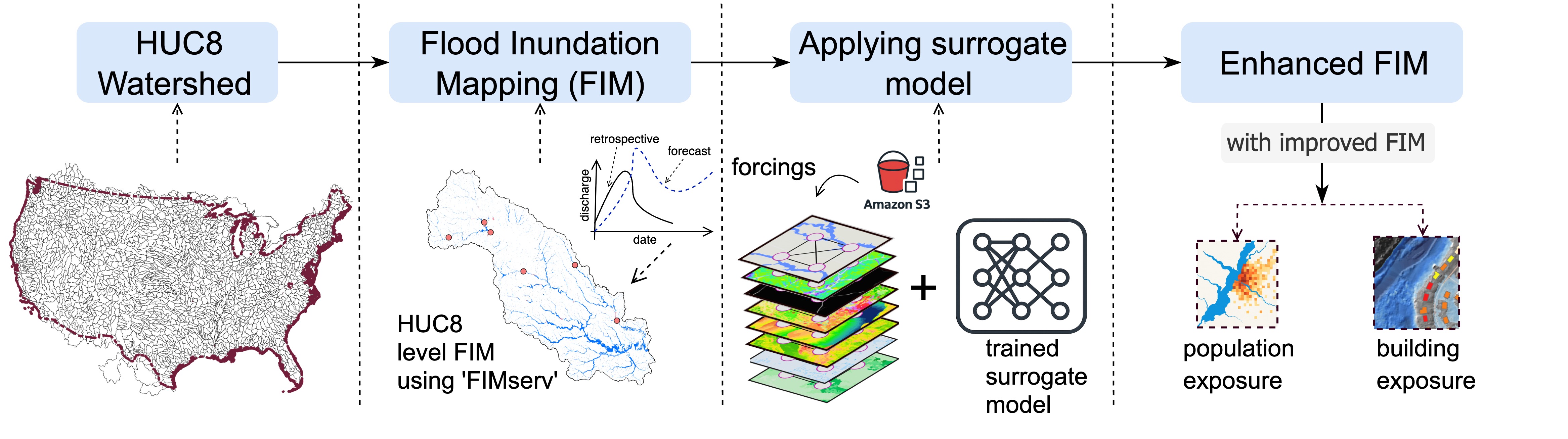
Imagine you're a flood forecaster at a National Weather Service office. A major storm is approaching and you need to tell emergency managers — right now — which neighborhoods will flood, to what depth, and within what time window. The problem? Running the high-fidelity hydraulic model that would answer those questions takes 8 hours per catchment. You have 10,000 catchments across the United States.
This is the central challenge that motivated my MS thesis at the University of Alabama: How do we make flood inundation mapping fast enough to actually inform operational decisions?
The Problem with Physics-Based Models
Physics-based models like HEC-RAS solve the full St. Venant equations of open-channel flow. They're accurate, physically interpretable, and trusted by engineers worldwide. But they're slow — computationally expensive in ways that make real-time or near-real-time forecasting extremely difficult at national scale.
NOAA's operational framework, the HAND-FIM (Height Above Nearest Drainage — Flood Inundation Mapping) system, is faster by design — it uses pre-computed synthetic rating curves to estimate inundation from streamflow forecasts. But it trades accuracy for speed. Can we have both?
Enter Surrogate Modeling
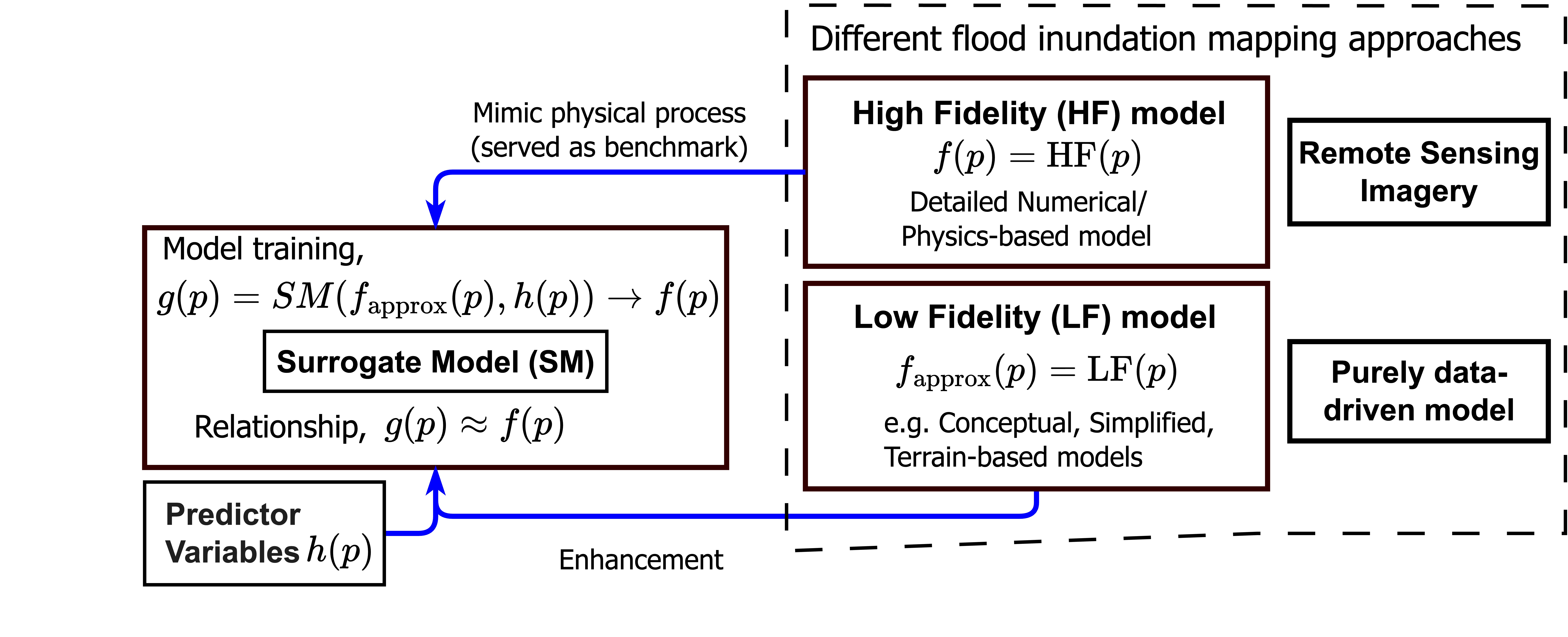
A surrogate model (also called an emulator or meta-model) learns the input-output behavior of a computationally expensive model and can then approximate that behavior at a fraction of the cost. Think of it as a very well-trained student who, after observing thousands of examples from their teacher, can answer similar questions without re-doing all the teacher's work.
"The goal wasn't to replace physics — it was to learn from physics and run at the speed of AI."
We trained a Convolutional Neural Network (CNN) on thousands of HEC-RAS simulation outputs, pairing streamflow conditions and watershed geometry features with the resulting flood inundation extents. The CNN learns spatial patterns in how flooding propagates across a watershed.
Key Results
- 35% improvement in accuracy over the baseline HAND-FIM approach when compared against observed flood extents.
- 10,000× speedup — what takes HEC-RAS hours takes our model milliseconds.
- National-scale applicability — the framework generalizes across diverse geomorphic settings across CONUS.
- Adopted by NOAA OWP — components of this work are now integrated into the operational forecasting pipeline.
What This Means for Disaster Response
When a hurricane is making landfall, flood forecasters don't have hours to run hydraulic models for every affected river segment. A surrogate model that runs in milliseconds — while retaining much of the physical accuracy — changes what's possible. Emergency managers can receive flood maps that update every 15 minutes as new streamflow forecasts arrive from the National Water Model.
Beyond speed, the open-source tooling we built around this work — FIMserv and FIMeval — makes these methods accessible to any researcher or agency that wants to use or extend them.
What's Next
We're now extending this work to include pluvial (urban) flooding — a type of flooding that happens when rainfall overwhelms stormwater infrastructure, often without any connection to rivers. This is among the deadliest and most common flood types, and it's currently underrepresented in NOAA's operational models. Stay tuned.