Back to research
GeoAI · Surrogate Modeling · HAND-FIM

GeoAI for Flood Inundation Mapping

Research Brief Updated May 8, 2026

Physics-aware surrogate ML models that learn spatial correction patterns from paired HAND-FIM and HEC-RAS outputs — achieving a 35% accuracy improvement and 10,000× computational speed-up over full hydraulic simulation while remaining deployable at national HAND-FIM scale.
GeoAISurrogate ModelingFlood MappingHEC-RASHAND-FIM
Surrogate modeling for flood inundation mapping

What This Research Covers

  • Systematic spatial comparison of OWP HAND-FIM and HEC-RAS hydraulic simulation outputs — characterizing agreement zones, inundation boundary errors, and conditions where HAND-FIM's simplified terrain assumptions diverge from physics-based baselines.
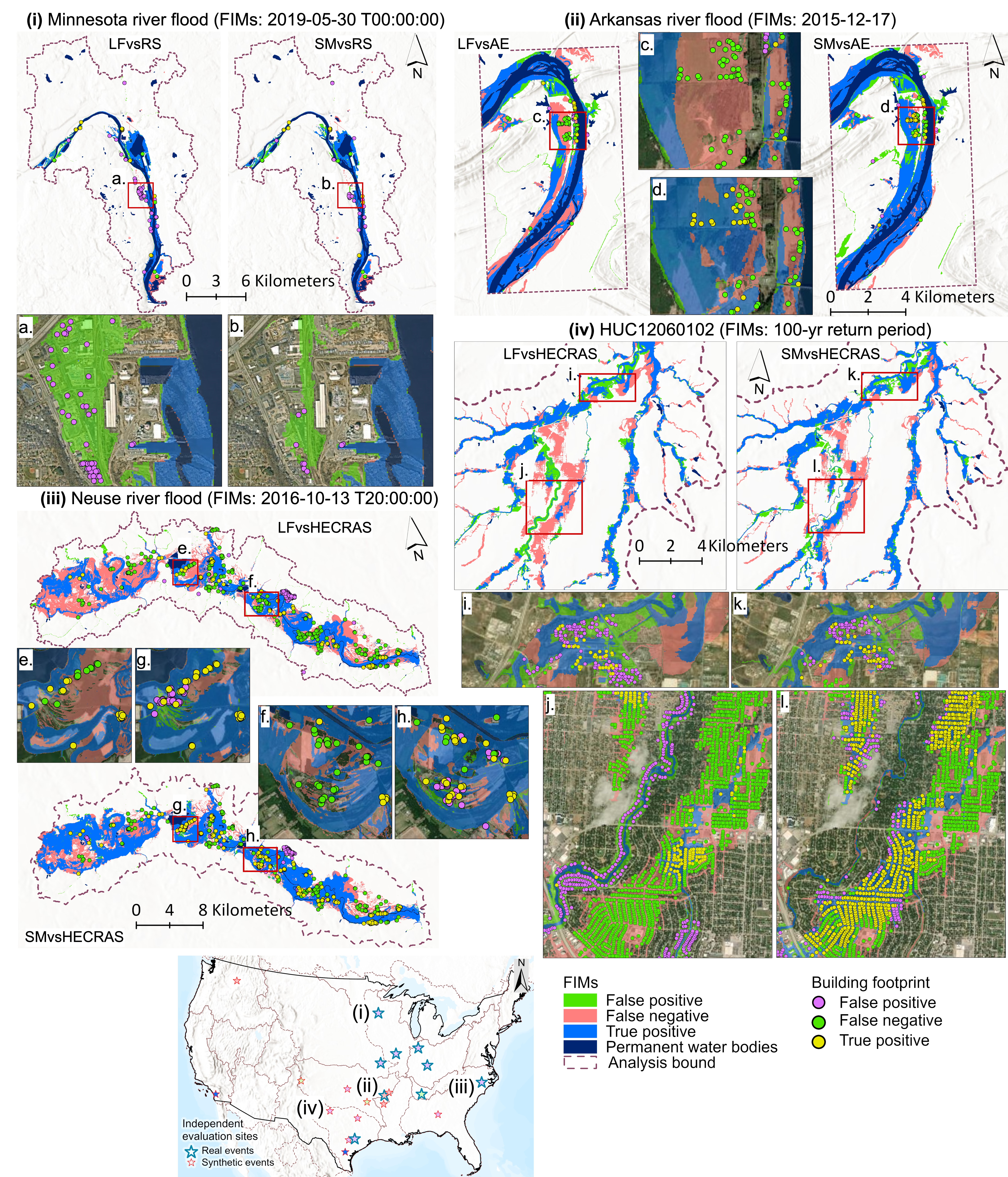
  • Physics-aware surrogate ML model trained on paired HAND-FIM/HEC-RAS outputs across diverse flood events, watersheds, and flow regimes, learning to predict the spatial correction needed to bring HAND-FIM closer to hydraulic accuracy.
  • Hybrid AI pipeline benchmarked at a 35% Critical Success Index improvement over HAND-FIM baselines and a 10,000× speed-up over full HEC-RAS simulation — unlocking real-time ensemble flood forecasting at national scale.
  • Scalable architecture designed for NOAA OWP's national HAND-FIM framework, driven by NWM streamflow inputs and deployable across CONUS catchments without per-watershed retraining.
  • Deep learning time-series models (LSTM) applied to weather and hydrologic forecasting, extending the GeoAI approach into climate and meteorological prediction contexts.

Why It Matters

NOAA's operational HAND-FIM system generates millions of flood predictions daily but its simplified terrain assumptions introduce systematic errors in complex floodplains. A surrogate model that bridges HAND-FIM's computational speed with HEC-RAS physical accuracy changes what is possible in real-time flood warning — ensemble probabilistic maps, scenario-based planning outputs, and high-resolution inundation extents become feasible where full hydraulic simulation was never an option. The 10,000× speed advantage is not an incremental improvement; it is the difference between a batch overnight run and a live operational product.

Related Outputs